
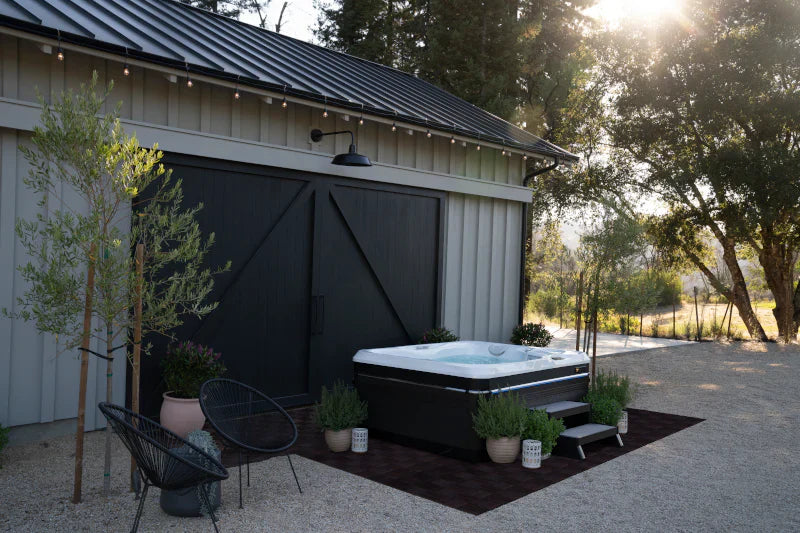
How do I Install a Hot Tub?
Everything You Need to Know About Electrical Requirements, Site Prep, Pad Options, Placement Strategy, and Access—Before Your Hot Tub Arrives
You’ve picked the perfect hot tub. Now comes the part that makes most people nervous: getting it installed. The good news? Installing a hot tub is far simpler than most people expect. There’s no plumbing to run, no complicated construction, and your dealer handles the heavy lifting—literally. But a little planning upfront can make the difference between an installation that goes smoothly and one that creates headaches for years to come.
In this guide, we’ll walk you through everything you need to prepare before your hot tub arrives—from understanding electrical requirements and choosing the right pad, to making smart placement decisions that will help you use your spa more often and enjoy it more when you do.
What Does Hot Tub Installation Actually Require?
A hot tub—also called a portable spa—is a completely self-contained unit. Unlike a built-in pool or in-ground spa, there’s no plumbing to connect. You need just four things:
- A solid, level surface to set the hot tub on
- Electricity (110V or 220V–240V, depending on the model)
- Access for the delivery crew to get the hot tub to its location
- A garden hose to fill the spa with water
That’s it. No plumber, no trenching, no major construction. Let’s break each piece down so you know exactly what to expect.
Power Requirements: 110V vs. 240V
This is the number one question we get from new hot tub buyers, and the answer is straightforward. Hot tubs are powered in one of two ways:
110V Plug-and-Play
Some smaller hot tubs—like the Hot Spring TX or select Freeflow and Fantasy models—run on a standard 110V household outlet. You literally plug the cord into an existing outdoor outlet, fill with water, and start soaking. This is ideal for renters, small patios, or buyers who want the simplest possible setup.
The trade-off: On a 110V circuit, the heater and jet pump can’t run at the same time. This means the water heats more slowly (1 kW heater), which is fine in warmer climates but can be limiting in Idaho’s cold winters. Most 110V models can be converted to 240V later if you decide you want faster heating.
220V–240V Hardwired (Most Common)
The majority of full-size hot tubs—including all Hot Spring Highlife and Limelight models, Sundance 780/880/980 Series, American Whirlpool, and Caldera—require a dedicated 240V electrical connection. This gives you a 4–6 kW heater that heats water quickly, even in sub-zero temperatures, and can run the heater and jets simultaneously.
Here’s what your electrician will need to do:
- Install a dedicated 50-amp, 240V breaker in your home’s main electrical panel (non-GFCI)
- Run 4-wire service (two hot, one neutral, one ground) using #6 AWG wire from the panel to a GFCI sub-panel near the spa
- Mount a GFCI sub-panel (included with most Hot Spring, Sundance, and Caldera spas) at least 5 feet from the spa but within line of sight, per NEC code
- Run conduit from the sub-panel to the spa’s control box, leaving 3 extra feet of wire for the final connection
Electrical Requirements at a Glance
| 110V Plug-and-Play | 220–240V Hardwired | |
|---|---|---|
| Circuit | Dedicated 15–20 amp GFCI outlet | Dedicated 50 amp, 240V breaker |
| Electrician Required? | Usually not | Yes – licensed electrician |
| Heater Power | 1 kW | 4–6 kW |
| Heater + Jets Together? | No – one at a time | Yes – simultaneous |
| Best For | Small spas, mild climates, renters | All full-size spas, cold climates |
| Typical Electrician Cost | $0 (plug-in) | $200–$600 |
| Idaho Recommendation | Good for summer-only use | Strongly recommended year-round |
Don’t wait until delivery day. Schedule your electrician as soon as you order your hot tub. The electrical work can (and should) be completed before the spa arrives so your dealer can fill, power up, and test the spa during delivery. Your Leisure Time Inc. dealer can recommend a trusted local electrician and provide the exact wiring specifications for your model.
Site Preparation: Choosing the Right Pad
Your hot tub needs a solid, level surface that can support significant weight. A filled 6-person hot tub with occupants can weigh 4,000–6,000 pounds or more. Never place a hot tub directly on bare grass, dirt, or an uneven surface—it will settle unevenly, stress the shell, and potentially void your warranty.
Here are the most common pad options, along with their pros, cons, and costs:
1. Poured Concrete Slab
The most popular and durable option. A reinforced concrete slab will easily last the life of your spa and beyond.
- Thickness: 4 inches minimum, reinforced with rebar or wire mesh. For larger spas (8+ person) or swim spas, consider 5–6 inches.
- Drainage: Pour with a very slight slope (¾” per 10 feet) so water drains away from the house and doesn’t pool under the spa.
- Cure time: Allow a minimum of 28 days for full cure before placing the spa.
- Cost: $4–$7 per square foot, or roughly $250–$500 for an 8’ × 8’ pad.
- Best for: Permanent installations, large spas, homeowners who want maximum stability and longevity.
2. Interlocking Pavers or Patio Blocks
Pavers offer an attractive, customizable foundation that integrates beautifully with landscaping.
- Preparation: Remove sod, lay 4–6 inches of compacted gravel, add 1 inch of leveling sand, then set the pavers. Use interlocking-style pavers for best stability.
- Paver thickness: 2–4 inches recommended.
- Cost: $500–$2,000 depending on paver style, or budget-friendly sidewalk blocks for under $300.
- Best for: Existing patios, homeowners who want an attractive finished look, integrating with outdoor living spaces.
3. Compacted Crushed Gravel
An excellent, cost-effective option that provides great drainage—a real advantage in Idaho’s freeze-thaw climate.
- Preparation: Frame the area with pressure-treated lumber or landscape timbers, lay weed barrier, fill with 4–6 inches of crushed stone (not round pea gravel—it won’t compact), and tamp firmly with a plate compactor.
- Important: Use crushed/angular gravel (often called #57 stone) that locks together when compacted. Round river rock will shift.
- Cost: $150–$400 for an 8’ × 8’ pad.
- Best for: Budget-friendly installations, natural settings, excellent drainage areas.
4. Pre-Fabricated Synthetic Spa Pad
Interlocking high-density plastic tiles that snap together to create an instant foundation.
- Setup: Assemble on any level, well-drained surface in under 30 minutes. Can be placed on compacted gravel, sand, or even an existing level surface.
- Advantages: Portable (great for renters), provides some insulation for the bottom of the spa, and can be disassembled and moved.
- Cost: $400–$700 depending on size.
- Best for: Renters, temporary placements, quick installations where the ground is already level.
5. Existing or Reinforced Deck
Many people want their hot tub on their deck, and that can work well—with some important caveats.
- Weight check: A filled 6-person spa weighs around 4,000–5,000 lbs. Most standard residential decks are NOT built for this load. Consult a structural engineer or contractor before placing a spa on any deck.
- Reinforcement: Additional joists, support posts, and/or concrete footings are typically required directly under where the spa will sit.
- Best for: Ground-level or low decks that can be reinforced, or new deck builds where the spa location is planned into the design.
Pad Options at a Glance
| Pad Type | Cost (8’×8’) | Durability | Drainage | Portability |
|---|---|---|---|---|
| Concrete Slab | $250–$500 | Excellent | Slope required | Permanent |
| Pavers | $500–$2,000 | Very Good | Good (gaps) | Semi-permanent |
| Crushed Gravel | $150–$400 | Good | Excellent | Semi-permanent |
| Synthetic Pad | $400–$700 | Good | Moderate | Fully portable |
| Reinforced Deck | $500–$2,000+ | Very Good | Built-in | Permanent |
How Big Should Your Pad Be?
Your pad should be larger than your hot tub. Here’s why: you need room to walk around the spa, space for a cover lifter, clearance for the sub-panel and equipment access, and room for steps. As a general rule, add at least 12–18 inches to every side of the hot tub footprint.
| Hot Tub Size | Typical Dimensions | Minimum Pad Size | Recommended Pad |
|---|---|---|---|
| 2–3 Person | 5’ × 5’ to 6’ × 6’ | 7’ × 7’ | 8’ × 8’ |
| 4–5 Person | 6’ × 6’ to 7’ × 7’ | 8’ × 8’ | 9’ × 9’ |
| 6–7 Person | 7’ × 7’ to 8’ × 8’ | 9’ × 9’ | 10’ × 10’ |
| 8+ Person | 8’+ × 7’–8’ | 10’ × 10’ | 11’ × 11’ or larger |
A slightly oversized pad costs very little extra but gives you room for steps, a towel bar, planters, or even a small bench—all of which make the space more functional and inviting. If you’re pouring concrete or laying pavers, an extra foot on each side is a small investment for a big improvement in the daily experience.
Smart Placement: Location Matters More Than You Think
Where you put your hot tub can dramatically affect how often you use it. Here are the most important placement considerations:
Put It Close to a Door
This is the single most important placement tip we can give you. The closer your hot tub is to a door—ideally your back door or a patio door—the more you’ll use it. This is especially true in Idaho, where stepping out into 20°F weather in a bathrobe is a lot more appealing when you’re 10 steps from the door versus 50.
We’ve seen it time and again: customers who place their spa at the far end of the yard use it half as often as those who put it right outside the door. The short walk also means you’re more likely to take a quick soak before bed, use it for morning coffee soaks, or hop in for 15 minutes after work—instead of making it a production every time.
A location close to the house also offers practical advantages: shorter electrical runs (which saves money on wiring), easier access to a garden hose, and a more natural transition between indoor and outdoor living space.
Think About the View from Inside the Spa
Once you’re in the hot tub, where will you be looking? Orient the spa so your seating faces the best view—your garden, the mountains, the sunset, or even a nice section of your yard. A simple test: set up a lawn chair exactly where you’re thinking of placing the hot tub, sit down at seat height (about 18–20 inches off the ground), and look around. What do you see? That’s your view from the spa.
Privacy and Wind Protection
Consider what your neighbors can see. Even a small privacy screen, section of fence, or strategically placed plantings can make a huge difference in comfort. Wind is another factor—especially in Idaho. Positioning the spa near the house, a fence, or a windbreak helps retain heat, reduces energy costs, and makes the soaking experience more enjoyable. Even your cover lifter can serve as a partial windbreak on one side.
Plan for Level Ground
If your preferred spot has any slope, you’ll need to level it before installation. A hot tub should have no more than ½ inch of slope across its entire footprint. If your yard slopes significantly, a concrete slab or retaining wall may be the best way to create a level pad without major grading.
Getting the Hot Tub to Your Backyard
A delivery crew will bring your hot tub on a trailer, then tip it on its side onto a specialized spa cart and wheel it to its final location. This means they need a clear path from the street to your backyard that is at least as wide as the hot tub is tall (typically 34–38 inches minimum for most models).
Before delivery day, walk the path yourself and consider:
- Gate width: Most backyard gates are 36 inches wide, which works for many spas. If yours is narrower, a fence section may need to be temporarily removed—a quick and common solution.
- Overhead clearance: Tree branches, low eaves, or pergola beams need to be above the height of the spa on the cart (roughly 6–7 feet).
- Ground conditions: The cart wheels work best on firm surfaces. If the path crosses soft ground or a muddy area, laying temporary plywood sheets can help.
- Tight turns: The spa on the cart is rigid. If the path has tight 90-degree turns, measure to confirm the spa can make the turn.
- Crane delivery: If there’s no ground-level path into your backyard, your dealer can arrange for a crane to lift the spa over the house and lower it into position. This typically costs $500–$1,000 but solves access problems that would otherwise be impossible.
Your Leisure Time Inc. team will help you plan the delivery route. We recommend walking the path together during the buying process so there are no surprises on delivery day. Take photos and measurements of gates, turns, and any tight spots. Planning ahead avoids delays and extra charges.
Plan for Future Service Access
Every hot tub will eventually need service—whether it’s a routine component replacement or a diagnostic visit from a technician. When choosing your placement, think about service access from day one:
- Equipment side access: Most hot tubs have an equipment compartment on one side (usually behind a removable panel). Leave at least 24–30 inches of clearance on this side so a technician can open the panel and work comfortably.
- Don’t box it in completely. It’s tempting to build the spa into a deck or surround it with permanent structures on all sides. But if the spa ever needs to be removed for major service, you’ll need a way to get it out. Leave at least one side fully accessible.
- Sub-panel visibility: The GFCI sub-panel must be within line of sight of the spa and no closer than 5 feet. Don’t hide it behind a shed or in a location that’s hard to reach—you’ll need to access it to reset breakers.
- Cover lifter clearance: Most cover lifters need 6–18 inches of clearance behind the spa (some hydraulic models need as little as 6 inches). Factor this into your pad size and placement.
How Your Cover Lifter Changes Your View
Here’s something most buyers don’t think about until after installation: where your cover lifter sits directly affects your view while soaking. When you remove the cover, the folded cover has to go somewhere—and that “somewhere” becomes a wall on one side of your spa.
Types of Cover Lifters and Their Impact
- Manual pivot lifters fold the cover in half and pivot it upright behind the spa. The cover sits vertically and blocks the view on that side. This is the most common and affordable option ($150–$300).
- Hydraulic lifters use gas-assist pistons to carry the cover’s weight. Most models position the cover the same way as a manual pivot, but some premium hydraulic models bring the cover all the way down to ground level behind the spa, preserving a full 360-degree view ($250–$500).
- Shelf lifters slide the folded cover onto a shelf beside the spa. This keeps the cover off the ground but takes up more lateral space ($100–$200).
- Undermount lifters attach under the spa (must be installed before filling), providing a clean look with no drilling into the cabinet ($200–$400).
The strategic move: Position your cover lifter on the side facing the least desirable view—your house wall, the neighbor’s fence, or any direction you don’t need to look. This way, when the cover is open, it acts as a privacy screen behind you while your best views (mountains, garden, sunset) remain completely unobstructed. Some customers even use the raised cover as an intentional wind block.
Decide which type of cover lifter you want and where it will go BEFORE you pour your pad or place your spa. This ensures you have the right clearance and your best view is preserved. If you want an undermount lifter, it must be installed before the spa is filled with water. Your Leisure Time Inc. team can walk you through the options in the showroom.
What to Expect on Installation Day
When you buy from Leisure Time Inc., we handle the delivery and placement. Here’s a typical installation day:
- Delivery crew arrives with the spa on a trailer and moves it to your prepared pad using a spa cart.
- Spa is positioned on the pad and leveled if needed.
- Cover lifter, steps, and accessories are installed.
- Spa is filled with a garden hose through the filter compartment.
- Electrician connects the wiring (if not done beforehand).
- Power is turned on, and the system self-primes and begins heating.
- Your dealer walks you through operation: controls, jets, water care startup, filter maintenance, and cover care.
Depending on the water temperature and your heater capacity, your spa will typically be ready for your first soak within 8–24 hours after filling.
Frequently Asked Questions
Do I need a permit to install a hot tub?
In most Idaho communities, a standard portable hot tub on an existing surface does not require a building permit. However, the electrical work typically does require an electrical permit, which your licensed electrician will handle. If you’re building a new deck, pouring a large concrete pad, or installing a fence, those may require separate permits. Check with your local building department—your Leisure Time Inc. team can also advise based on your specific city.
Can I install a hot tub indoors?
Yes, but it requires careful planning for ventilation (humidity control), structural support (the floor must handle the weight), drainage, and adequate headroom. Indoor installations are less common but absolutely possible with the right preparation.
How long does the whole process take from purchase to first soak?
If your pad and electrical are ready, most customers are soaking within 1–2 days of delivery. The longest part of the process is usually waiting for the electrician or for concrete to cure. If you start planning early, many customers complete everything within 2–4 weeks of purchase.
Do hot tubs need plumbing?
No. Hot tubs are completely self-contained. You fill them with a garden hose, and they recirculate and filter the same water internally. No plumber needed.
What if my yard has no access for a delivery cart?
Your dealer can arrange a crane delivery, where the spa is lifted over the house and lowered into the backyard. It’s more common than you’d think, and our team handles the logistics.
Can I move my hot tub later?
Yes. Portable spas are designed to be moved. Drain the water, disconnect the power, and have a moving crew (or your dealer) relocate it using a spa cart. This is another reason to avoid boxing the spa in on all sides.
At Leisure Time Inc., installation support is part of the experience—not an afterthought. From your first showroom visit, our team will help you plan the perfect location, recommend the right pad, provide electrical specifications for your electrician, coordinate delivery logistics, and get you soaking as quickly and smoothly as possible.
The best hot tub installation starts with a great plan.
Browse Hot Tubs: leisuretimeinc.com/collections/hot-tubs
Shop Accessories & Water Care: shop.leisuretimeinc.com
Hot Spring Pre-Delivery Instructions: hotspring.com/learning-center/pre-delivery-instructions
Financing Options: leisuretimeinc.com/pages/financing
Locations: leisuretimeinc.com/pages/locations