
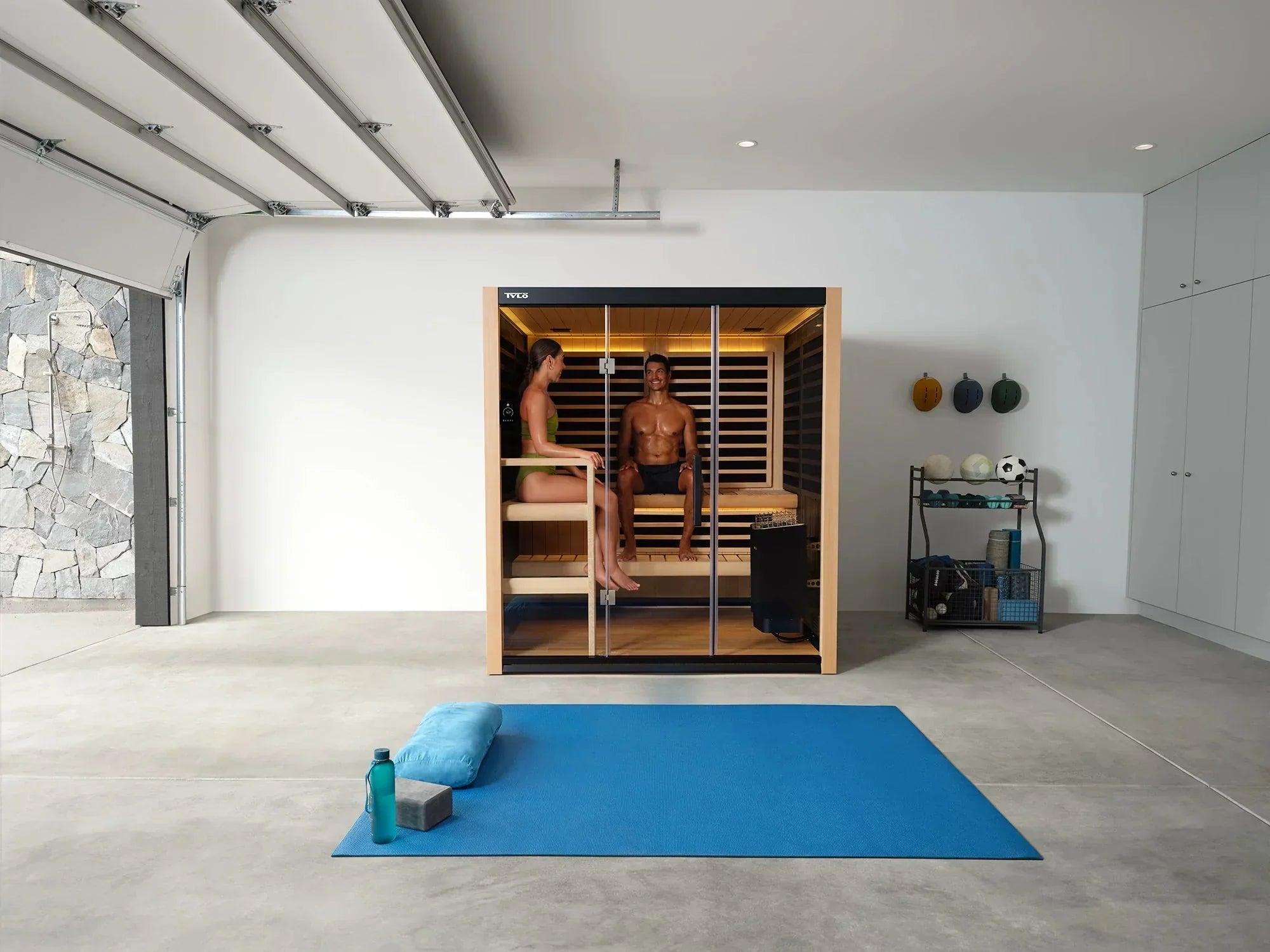
Infrared Vs Traditional Saunas: What's the Difference?
How They Work, How They Feel, and Which One Is Right for Your Health Goals
If you’re researching saunas for your home, you’ve probably come across two main types: traditional Finnish saunas and infrared saunas. They both make you sweat. They both feel great. And they both offer real health benefits. But the way they deliver heat—and the experience of sitting in each one—is fundamentally different.
Understanding these differences will help you choose the sauna that best matches your health goals, your heat tolerance, your space, and how you want to use it day to day.
At Leisure Time Inc., we carry both types—plus hybrids that combine them. Finnleo offers traditional, infrared, and InfraSauna (hybrid) models. Tylö offers traditional saunas, infrared options, and their innovative Sense Combi heater that adds a “Soft Sauna” steam mode. In this guide, we’ll give you an honest, side-by-side comparison so you can make the right decision.
How They Work: Two Completely Different Approaches to Heat
Traditional Finnish Sauna
A traditional sauna heats the air in a wood-lined room using an electric heater (or wood-burning stove) loaded with rocks. The air temperature reaches 170–195°F (77–90°C) with low humidity (10–20%). You can create bursts of steam (löyly) by ladling water over the hot rocks, temporarily raising the humidity and intensifying the heat. Your body heats from the outside in—the hot air warms your skin, which gradually raises your core body temperature. This triggers a powerful cascade of physiological responses: vasodilation, elevated heart rate (from a resting 60–70 bpm to 110–120+ bpm), profuse sweating, endorphin release, and heat shock protein production. Finnleo notes that this cardiovascular response is similar to moderate-intensity exercise.
Infrared Sauna
An infrared sauna uses infrared light panels to heat your body directly—rather than heating the air around you. The air temperature stays much lower at 120–150°F (49–65°C), but the infrared waves penetrate 1–2 inches into your skin and tissues, raising your core temperature from the inside out. Because the air is cooler, many people find infrared saunas more comfortable and tolerable for longer sessions (30–45 minutes vs. 15–20 for traditional). You still sweat deeply—but through a different mechanism. The experience is gentler, quieter, and more meditative. Finnleo’s CarbonFlex infrared heaters are designed with proprietary low EMR/EF technology to minimize electromagnetic radiation exposure during your session.
Traditional saunas heat the air, which heats your body from the outside in. Infrared saunas heat your body directly from the inside out. Both raise your core temperature and make you sweat—but the experience, the intensity, and the session length are very different.
Infrared vs. Traditional: Head-to-Head Comparison
| Traditional Finnish Sauna | Infrared Sauna | |
|---|---|---|
| Heat Method | Heats the air via electric heater/rocks | Heats the body directly via infrared light panels |
| Temperature | 170–195°F (77–90°C) | 120–150°F (49–65°C) |
| Humidity | 10–20% (dry); higher with löyly | Very low / ambient |
| How You Heat Up | Outside in (air → skin → core) | Inside out (infrared → tissue → core) |
| Steam Option | Yes – ladle water over rocks | No |
| Session Length | 15–20 minutes per round | 30–45 minutes |
| Warm-Up Time | 30–60 minutes | 10–20 minutes |
| Heat Intensity | Intense, enveloping | Gentle, penetrating |
| Heart Rate Response | 110–150+ bpm (similar to moderate exercise) | Elevated, but generally lower than traditional |
| Sweat Type | Surface sweat (evaporates naturally) | Deep tissue sweat (some report “oilier” quality) |
| Social Experience | Excellent – traditional communal activity | Good – typically quieter, more personal |
| Construction | Wood-lined room (cedar, spruce, hemlock) | Wood-lined room or prefab cabin |
| Electrical | 240V, 30–50 amp dedicated circuit | Many models run on standard 120V outlet |
| Energy Cost | ~$4–$6/month (3x/week) | ~$3–$5/month (3x/week) |
| Price Range | $4,000–$20,000+ | $2,500–$10,000+ |
Health Benefits: What the Research Says
Traditional Sauna: The Gold Standard of Research
The traditional Finnish sauna has the strongest body of long-term, large-scale medical research of any heat therapy. The key findings:
- Cardiovascular health: The KIHD study (2,300+ men, 20+ years) found that 4–7 sauna sessions/week was associated with a 50% lower risk of cardiovascular mortality and a 52% lower risk of sudden cardiac death for sessions over 19 minutes.
- Brain health: The same study found a 65% lower risk of Alzheimer’s and dementia with frequent sauna use. A second study of 13,994 men and women confirmed the association.
- Blood pressure and stroke: Regular traditional sauna use was associated with reduced risk of hypertension and stroke.
- Heat shock proteins and BDNF: The intense heat of a traditional sauna strongly stimulates heat shock protein production (cellular repair) and brain-derived neurotrophic factor (neuron growth and protection).
- Growth hormone: Traditional sauna temperatures (176–212°F) are more effective at promoting growth hormone release, which supports muscle repair and recovery.
- Respiratory health: Studies have found that frequent sauna use reduces the risk of respiratory diseases by 27–41%, and regular sauna users experience fewer colds.
Infrared Sauna: Growing Evidence, Different Strengths
Infrared saunas have less long-term, population-scale research than traditional saunas, but the existing evidence is promising—and growing. Key findings:
- Chronic pain: Research published in Clinical Rheumatology found that infrared sauna sessions significantly reduced pain and stiffness in patients with rheumatoid arthritis, ankylosing spondylitis, and chronic musculoskeletal conditions. This is infrared’s strongest research advantage.
- Cardiovascular support: Systematic reviews found that infrared sauna therapy (including Waon therapy) improved cardiac function, exercise tolerance, and vascular health in patients with chronic heart failure. A meta-analysis showed improved cardiovascular markers after ~15-minute sessions, 5x/week.
- Chronic fatigue syndrome: Small clinical trials found that infrared sauna use helped reduce symptoms in patients with chronic fatigue syndrome.
- Muscle recovery: Infrared heat has been shown to improve post-workout recovery and reduce delayed-onset muscle soreness (DOMS).
- Detoxification: Studies confirm that sweat induced by infrared heat contains trace amounts of heavy metals (arsenic, cadmium, lead, mercury). Infrared’s deeper tissue penetration may enhance this process.
- Accessibility: Because infrared operates at lower temperatures, it’s a viable option for people who can’t tolerate the intense heat of a traditional sauna—including some elderly users and people with certain cardiovascular conditions.
Traditional saunas have the strongest long-term evidence for cardiovascular protection, brain health, and longevity. Infrared saunas have the strongest evidence for chronic pain relief, gentle cardiovascular support, and accessibility for heat-sensitive users. Both offer genuine, research-supported health benefits.
How They Feel: The Experience Difference
Traditional Sauna Experience
Walking into a traditional sauna at 180°F+ is an immediate, enveloping sensation. The heat is everywhere—in the air, radiating from the rocks, rising from the wooden benches. When you ladle water over the rocks, the burst of steam (löyly) temporarily intensifies the heat dramatically. Your skin flushes, your heart rate climbs, and within minutes, you’re sweating profusely. It’s intense, invigorating, and deeply satisfying. Most people describe it as a “cardiovascular workout without moving.” The traditional sauna is also inherently social—in Finland, it’s a communal activity where families and friends gather, talk, and share the experience.
Infrared Sauna Experience
An infrared sauna feels very different. The air is warm but not oppressively hot. You sit down, the infrared panels glow gently around you, and the heat builds slowly in your body rather than hitting you all at once. After 15–20 minutes, you’re sweating deeply—but you’re comfortable, relaxed, and breathing easily. Many users describe it as “sitting in warm sunshine.” The lower air temperature makes it ideal for people who find traditional saunas too intense, and the longer sessions (30–45 minutes) lend themselves to meditation, reading, or simply unwinding.
Installation and Practical Considerations
Traditional Sauna
- Space: Requires a wood-lined room (cedar, spruce, or hemlock). Minimum 4’×4’ for 1–2 people; 5’×7’ to 6’×8’ for families.
- Electrical: Most heaters require a 240V, 30–50 amp dedicated circuit. Requires a licensed electrician.
- Warm-up: 30–60 minutes to reach full temperature.
- Ventilation: Simple intake and exhaust vents.
- Prefab kits: Finnleo and Tylö both offer modular kits that can be assembled in a day.
- Cost: $4,000–$20,000+ depending on size and customization.
Infrared Sauna
- Space: Compact prefab cabins start as small as 3’×3’ for a single person. Larger models fit 2–4 people.
- Electrical: Many models plug into a standard 120V household outlet. No electrician needed.
- Warm-up: 10–20 minutes (or use immediately—the benefit comes from the infrared exposure, not the air temp).
- Ventilation: Minimal requirements.
- Portability: Many infrared cabins can be disassembled and moved. Great for renters or temporary spaces.
- Cost: $2,500–$10,000+ depending on size and features.
Can’t decide? Finnleo’s InfraSauna combines both traditional and infrared heating in a single unit—so you can run a traditional session with rocks and steam one day, and a gentle infrared session the next, all in the same room. Tylö’s Sense Combi heater adds a “Soft Sauna” steam mode to any traditional room, offering yet another way to customize your experience.
Which One Is Right for You?
Choose a traditional Finnish sauna if:
- Cardiovascular conditioning, brain health, and longevity are your primary goals
- You want the strongest, most extensively researched heat therapy
- You enjoy intense heat and the ritual of löyly (steam from the rocks)
- You want a social, communal sauna experience
- You want to maximize heat shock protein and growth hormone production
Choose an infrared sauna if:
- Chronic pain relief, muscle recovery, or gentle detoxification are your priorities
- You find traditional sauna temperatures too intense or uncomfortable
- You want a shorter warm-up time and a more meditative, relaxed session
- You need a plug-and-play solution that runs on a standard 120V outlet
- You have limited space or want a portable option
Choose a hybrid (InfraSauna) if:
- You want the flexibility to switch between traditional and infrared depending on your mood and goals
- You want one sauna that does everything—intense cardiovascular heat one day, gentle recovery the next
- You’re investing in a long-term wellness space and want maximum versatility
Frequently Asked Questions
Is one type of sauna healthier than the other?
Not categorically. Traditional saunas have stronger long-term research for cardiovascular and brain health. Infrared saunas have stronger evidence for chronic pain and gentle cardiovascular support. Both offer genuine benefits. The best sauna for your health is the one you’ll use consistently.
Can I get the same benefits from infrared as traditional?
Many of the physiological responses overlap—both types elevate core temperature, increase circulation, promote sweating, and trigger stress-adaptation pathways. However, the intensity of the heat stress is different, and traditional saunas produce a stronger cardiovascular response and heat shock protein activation. If you’re primarily targeting longevity and heart health, traditional has the edge. For pain relief and accessibility, infrared excels.
Do infrared saunas really detox better than traditional?
The claim that infrared produces “deeper” detoxification is popular but not conclusively proven. Both types induce deep sweating, and studies confirm that sweat from both contains trace heavy metals. The deeper tissue penetration of infrared may enhance this process, but more research is needed to confirm a meaningful difference.
How much do home saunas cost to operate?
Very little. Finnleo reports that a traditional sauna used 3 times per week costs approximately $4–$6/month. Infrared saunas cost approximately $3–$5/month. Both are comparable to running a common household appliance.
What’s the difference between Finnleo and Tylö?
Both are part of the same parent company (Sauna360/TylöHelo) and share Scandinavian craftsmanship. Finnleo has been a leading U.S. sauna brand for 36+ years, known for traditional, infrared, and InfraSauna hybrids. Tylö, founded in Sweden in 1949, is renowned for innovative heater technology—including the Sense Combi and Soft Sauna concept. Both are available at Leisure Time Inc.
Can I try both types before buying?
Yes! Visit our showrooms in Boise, Idaho Falls, or Twin Falls. We have working sauna displays so you can feel the difference between traditional and infrared heat firsthand.
At Leisure Time Inc., we carry a full lineup of Finnleo and Tylö saunas—traditional Finnish, infrared, and hybrid models—in a range of sizes and configurations to fit any home. Our sauna specialists will help you choose the right type based on your health goals, heat preference, space, and budget.
The best sauna is the one you’ll use every day. Let us help you find it.
Browse Finnleo Saunas: leisuretimeinc.com/collections/finnleo-saunas
Browse Tylö Saunas: leisuretimeinc.com/collections/tylo-saunas
Shop Sauna Accessories: shop.leisuretimeinc.com
Learn More: finnleo.com/sauna-health-wellness-benefits
Locations: leisuretimeinc.com/pages/locations
Boise: (208) 376-0180 • Idaho Falls: (208) 523-4633 • Twin Falls: (208) 933-4295