
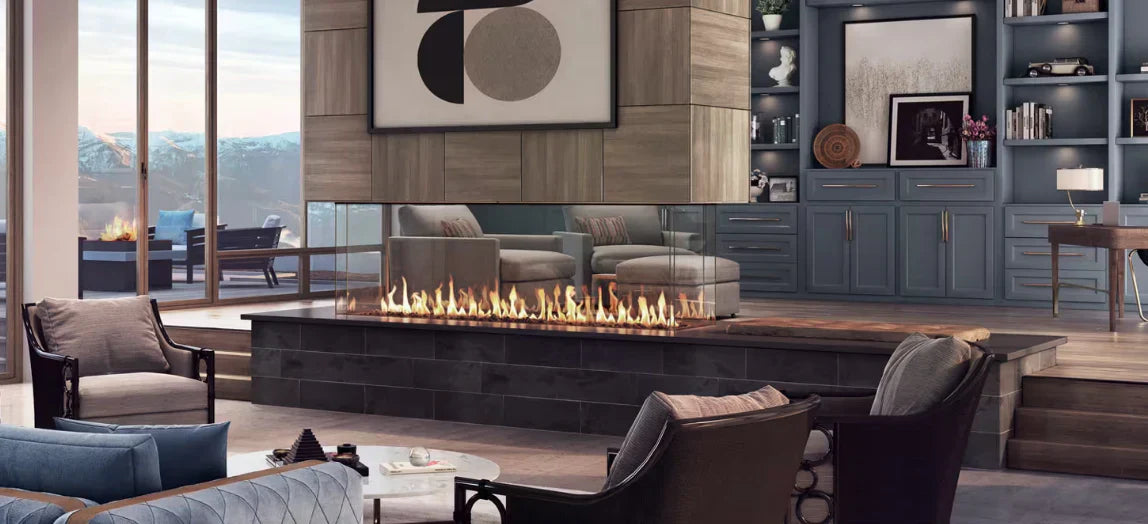
How Much Does It Cost to Install a Fireplace?
A Line-by-Line Breakdown of Installation Costs for Built-In Fireplaces—and How to Prepare Before Your First Consultation
You’ve chosen the fireplace. You know the fuel type. Now comes the question that determines whether the project fits your budget: how much does it actually cost to install it?
The fireplace unit gets most of the attention, but installation is where the real budget lives. Venting, framing, gas line work, electrical, permits, finishing materials—these line items can add anywhere from $1,500 to $10,000+ to your project, depending on the complexity of your home and the look you’re after.
In this guide, we’re breaking down every installation cost for built-in fireplaces (also called zero-clearance fireplaces)—the type that frame directly into a wall. We’ll cover gas, wood-burning, and electric models. And we’ll walk you through exactly what to do before visiting a Leisure Time Inc. showroom or scheduling a consultation so that we can give you the most accurate estimate possible on the first visit.
As a rule of thumb, budget 25–50% of the fireplace unit’s price for installation, venting, and related work—and then set aside an additional budget for finishing materials. A $3,000 gas fireplace might cost $1,500–$3,000 to install, and the finishing could add $500 to $8,000+ depending on how simple or dramatic you want the final look.
Installation Costs: Line by Line
Every fireplace installation is made up of several distinct components. Not every project requires all of them, and the cost of each varies based on your home, your fuel type, and your specific fireplace model. Here’s what each line item covers and what it typically costs.
1. Venting
Venting is the system that exhausts combustion byproducts outside your home and (for gas fireplaces) draws fresh combustion air in from outside. It’s usually the single largest installation expense.
Gas fireplace venting (direct vent): Modern gas fireplaces from Heat & Glo, Heatilator, Kozy Heat, and Valor all use direct vent technology—a sealed, co-axial pipe system that can exit horizontally through an exterior wall or vertically through the roof. Horizontal venting is simpler and less expensive because it requires a shorter pipe run and no roof penetration. Vertical venting is necessary when the fireplace is on an interior wall or when the homeowner prefers to conceal the vent termination on the roofline rather than on an exterior wall.
| Gas Venting Scenario | Typical Cost (Parts + Labor) |
|---|---|
| Horizontal through exterior wall – short run (under 10 ft) | $400 – $800 |
| Horizontal through exterior wall – longer run or with elbows | $800 – $1,500 |
| Vertical through ceiling and roof – single story | $800 – $1,500 |
| Vertical through ceiling and roof – multi-story | $1,500 – $2,500+ |
| Power vent system (for challenging vent runs) | $500 – $1,200 additional |
Wood fireplace venting (Class A chimney pipe): Wood-burning fireplaces require insulated Class A chimney pipe rated for high flue temperatures. This pipe is larger and more expensive than direct vent pipe. If the chimney runs through the ceiling and roof, you’ll also need firestop spacers at each penetration, a storm collar, a rain cap, and possibly an exterior chimney chase framed from wood and finished with siding to match your home.
| Wood Venting Scenario | Typical Cost (Parts + Labor) |
|---|---|
| Class A chimney pipe – single story through roof | $1,500 – $3,500 |
| Class A chimney pipe – multi-story | $2,500 – $4,500+ |
| Exterior chimney chase (framing + siding + cap) | $2,000 – $5,000+ |
Electric fireplace venting: None required. This is the single biggest installation advantage of electric fireplaces like the Kozy Heat Osseo eSeries or Heat & Glo Allusion. No pipe, no roof penetration, no exterior wall penetration, no associated labor. Savings on venting alone: $1,000–$4,000 compared to gas or wood.
Venting components are sold separately from the fireplace unit. On shop.leisuretimeinc.com, you’ll find gas vent pipe, pellet vent pipe, and accessories. Our installation team specs your exact venting needs during the planning phase so every component is accounted for before installation day.
2. Framing
Every built-in fireplace needs a framed cavity—a wood or steel stud enclosure built into the wall to house the firebox. The size of this cavity is determined by the manufacturer’s installation manual, which specifies exact clearances to combustible materials. This is not a place for guesswork—clearances vary by brand and model.
For new construction, the framing is typically part of the builder’s scope and adds relatively little to the overall framing budget—often just a few hundred dollars in additional labor and materials. For remodels, framing is a dedicated line item.
| Framing Scenario | Typical Cost |
|---|---|
| New construction (included in builder’s framing scope) | $200 – $500 incremental |
| Remodel – simple single-wall installation | $500 – $1,200 |
| Remodel – bump-out or wall extension | $1,000 – $2,500 |
| Remodel – chimney chase on exterior wall (wood) | $1,500 – $3,000+ |
| Multi-sided fireplace (see-through, peninsula, corner) | Add $500 – $1,500 |
Brands like Valor specify clearances down to ½”, and their HeatShift technology can reduce the required clearance above the fireplace—which means your framing cavity can be smaller and your mantel can be mounted closer to the firebox. The Heat & Glo SlimLine series requires only a 16”-deep cavity, which is ideal for remodels where wall depth is limited. Your Leisure Time Inc. specialist will reference the manufacturer’s installation manual for your exact model to spec the framing correctly.
3. Gas Line
Gas fireplaces require a dedicated gas supply line sized for the appliance’s BTU rating. If your home already has a gas line stubbed to the fireplace location (common in new construction), the connection cost is minimal. If a new line needs to be run from your gas meter, costs depend on the distance and routing complexity.
| Gas Line Scenario | Typical Cost |
|---|---|
| Connection to existing gas stub | $100 – $250 |
| New gas line run – short distance (under 30 ft) | $300 – $600 |
| New gas line run – longer distance or complex routing | $600 – $1,000+ |
| Propane tank sizing verification and regulator | $100 – $300 |
All gas line work must be performed by a licensed professional and pressure-tested before the fireplace is connected. If your home uses propane rather than natural gas, the fireplace will need a propane conversion kit (typically $50–$150, available for most models). Confirm your propane tank is adequately sized for the appliance’s BTU draw.
4. Electrical
Most modern gas fireplaces require a standard 120V electrical outlet inside or adjacent to the framed cavity. This powers fans, accent lighting, electronic ignition systems (like the IntelliFire system used in Heat & Glo, Heatilator, and Kozy Heat models), and optional WiFi modules. Many Valor gas fireplaces are unique in that they can operate entirely without electricity—their radiant heat system uses no fans—though an outlet is still recommended for optional features.
Electric fireplaces require a dedicated electrical circuit. Smaller models can run on a standard 15-amp circuit, but larger high-output linear models may need a 20-amp dedicated circuit.
| Electrical Work | Typical Cost |
|---|---|
| New 120V outlet inside framing cavity | $200 – $400 |
| Dedicated 20-amp circuit (large electric fireplaces) | $300 – $500 |
| Outlet already present (no work needed) | $0 |
5. Permits and Inspections
Most Idaho municipalities require a building permit for fireplace installations that involve structural framing, gas line work, or chimney penetrations. Some jurisdictions require separate permits for mechanical (gas) and structural (framing) work. Your installer will know the local requirements for Boise, Idaho Falls, Twin Falls, and surrounding areas.
| Permit Type | Typical Cost |
|---|---|
| Building permit (structural / framing) | $50 – $200 |
| Mechanical permit (gas line) | $50 – $150 |
| Inspection fees (if separate) | $50 – $150 |
| Electric-only installation (often no permit required) | $0 |
6. Professional Installation Labor
This is the hands-on work of setting the firebox into the framed cavity, connecting the venting, hooking up the gas and electrical, testing the appliance, and verifying safe operation. Installation labor is often bundled with venting costs, but some companies itemize it separately.
| Installation Labor | Typical Cost |
|---|---|
| Gas fireplace – standard installation | $500 – $1,500 |
| Gas fireplace – complex installation (multi-sided, long vent runs) | $1,500 – $2,500+ |
| Wood fireplace – standard installation | $800 – $2,000 |
| Electric fireplace – basic (plug-in, no framing needed) | $0 – $300 |
| Electric fireplace – built-in (with framing and electrical) | $300 – $800 |
7. Finishing Materials and Labor
Finishing is where your fireplace becomes a design statement—and it’s the most variable line item. This includes the surround material, the mantel, and any accent treatments. For a detailed breakdown of finishing options and prices, see our companion blog “How Much Does a Fireplace Cost?” Here’s the summary:
| Finishing Option | Typical Cost |
|---|---|
| Drywall, paint, and trim (clean / minimal) | $300 – $800 |
| Tile surround | $500 – $1,500 |
| Stacked stone section | $2,000 – $5,000 |
| Floor-to-ceiling stone feature wall | $3,000 – $8,000+ |
| Mantel shelf (basic to custom wood beam) | $100 – $1,500 |
| Full mantel surround (custom) | $800 – $5,000+ |
| Media wall with TV mount, shelving, cabinetry | $2,000 – $10,000+ |
Total Installation Cost by Fuel Type
Here’s what to expect when you add up all the installation line items—venting, framing, gas/electrical, permits, labor, and finishing. These ranges assume a typical single-story home with moderate finishing.
| Simple Install | Moderate Install | Premium Install | |
|---|---|---|---|
| Gas fireplace (horizontal vent, basic finish) | $2,000 – $3,500 | $3,500 – $6,500 | $6,500 – $12,000+ |
| Gas fireplace (vertical vent, stone/media wall) | $3,500 – $5,500 | $5,500 – $9,000 | $9,000 – $15,000+ |
| Wood fireplace (chimney + chase + finish) | $4,000 – $7,000 | $7,000 – $12,000 | $12,000 – $18,000+ |
| Electric fireplace (built-in with finish) | $500 – $1,500 | $1,500 – $4,000 | $4,000 – $10,000+ |
*These are installation costs only and do not include the fireplace unit itself. Add the unit price to these ranges for your total project budget.
The most expensive surprises in fireplace installation come from two sources: unexpected venting complexity (a second-story installation that requires additional pipe and firestops) and underestimating finishing costs (that floor-to-ceiling stone wall you fell in love with on Pinterest). The best way to avoid surprises is to bring as much information as possible to your first consultation so we can give you an accurate, all-in estimate.
How to Prepare Before Your Consultation
The more information you bring to your first visit at Leisure Time Inc., the faster and more accurate your project estimate will be. Here’s exactly what our hearth specialists need from you to give you a reliable quote.
What to Know About Your Home
- Is this new construction or a remodel? New construction projects are typically simpler because framing, gas, and electrical can be roughed in during the build. Remodels may involve opening up finished walls, rerouting utilities, and working around existing structures.
- Where in your home do you want the fireplace? Which room? Which wall? Is it an exterior wall (simplest for gas venting) or an interior wall (may require a longer or vertical vent run)? Bring a photo of the wall if possible.
- How many stories is your home? Single-story vertical vent runs are less expensive than multi-story runs. If the fireplace is on the first floor of a two-story home, the vent pipe passes through the second-floor framing, adding cost.
- Do you have an existing gas line nearby? If there’s already a gas stub or a gas appliance (furnace, water heater, range) near the fireplace location, running a gas line will be shorter and cheaper. If you’re on propane, know your tank size.
- What are your exterior wall materials? Brick, stucco, siding—each affects the cost of penetrating the wall for a vent termination. Brick and stucco require specialized cutting tools.
- Do you have a basement, crawlspace, or slab foundation? This affects how gas and electrical lines are routed to the fireplace location.
What to Know About Your Vision
- Fuel type preference: gas, wood, or electric? This determines the venting, gas line, and chimney requirements. If you’re unsure, that’s fine—our specialists will help you decide based on your goals and budget.
- Do you want it primarily for heat, ambiance, or both? This affects the BTU output and model selection, which in turn affects the venting and framing requirements.
- Traditional or contemporary style? Traditional fireplaces have different framing and finishing requirements than wide linear models. Knowing your style helps us narrow down models and finishing options quickly.
- Do you want a TV above the fireplace? If yes, we’ll recommend models with built-in heat management—like Valor’s HeatShift technology or Heat & Glo’s heat management systems—that allow safe TV mounting with minimal clearance.
- What finishing look are you going for? Bring photos or screenshots from Pinterest, Houzz, or Instagram. We see hundreds of installations, and a picture tells us immediately what the project will involve and approximately what it will cost.
- What is your overall budget? Being upfront about budget allows us to steer you toward the best combination of fireplace model, venting approach, and finishing that delivers the most value for your investment.
Leisure Time Inc. has Hearth Project Planners available on our website at leisuretimeinc.com/pages/hearth-project-planning. Print one off and fill it out before coming in—it covers all the key questions and helps you organize your thoughts before your consultation.
Your Consultation Checklist
Bring these items to your showroom visit or have them ready for a phone or video consultation:
- Photos of the room and wall where the fireplace will be installed (include at least one wide shot and one close-up of the wall area)
- Measurements: wall width, floor-to-ceiling height, and the depth of the wall (if it’s a partition wall or bump-out)
- Home floor plan or builder drawings (if available—especially helpful for new construction)
- Gas line information: Do you have natural gas or propane? Do you know where the meter or tank is located relative to the fireplace wall?
- Inspiration photos: screenshots of fireplaces, surrounds, mantels, and media walls you love
- Your budget range: even a rough “I’d like to stay under $X” helps enormously
- Timeline: when do you need the project completed? Are you building a new home with a specific move-in date?
What Happens After Your Consultation
Here’s what a typical fireplace project looks like once you’ve met with a Leisure Time Inc. hearth specialist:
- Product Selection and Estimate. Based on your consultation, we’ll recommend specific fireplace models and provide a detailed project estimate that includes the unit, all venting components, installation labor, and a finishing recommendation. This is a free, no-obligation estimate.
- Order Placement. Most fireplace units are special-ordered directly from the manufacturer with an estimated lead time of 14–21 business days. We’ll submit your order within 72 hours of receiving your deposit.
- Pre-Installation Preparation. While the fireplace is being manufactured, any framing, gas line, and electrical work can be completed. For remodels, this is when the wall is opened up and the cavity is built. For new construction, this work aligns with your builder’s framing and rough-in schedule.
- Fireplace Installation. Once the unit arrives and the cavity is prepared, our installation team sets the firebox, connects the venting, hooks up the gas and electrical, and performs a test fire and safety check. For a straightforward gas installation, this typically takes one day.
- Finishing. After the fireplace is installed and tested, the finishing work begins—tile, stone, mantel, drywall, paint, or media wall construction. This may be handled by our team, your general contractor, or a specialty trade, depending on the scope.
- Final Inspection. If your municipality requires a permit, a building inspector will verify that all gas, electrical, and structural work meets code. Your Leisure Time Inc. installer coordinates this process.
- Walkthrough and Enjoyment. We’ll walk you through operating your new fireplace—how to use the remote, adjust the flame, operate the blower, and maintain the unit. Then we hand you the keys to your new favorite room.
From first consultation to first fire, most projects take 3–6 weeks depending on manufacturer lead times and finishing complexity. New construction projects are coordinated with your builder’s schedule and can be longer. Planning during spring or summer means shorter lead times and more installer availability.
Factors That Increase (or Decrease) Installation Cost
These factors increase cost:
- Interior wall placement (requires longer or vertical vent run instead of a short horizontal exit)
- Multi-story vent run (pipe passes through second floor, adding firestops and pipe length)
- Chimney chase construction (exterior wood-framed chase for vertical venting, common with wood-burning fireplaces)
- Multi-sided configurations (see-through, peninsula, and corner fireplaces need framing on multiple sides and more complex finishing)
- Premium finishing materials (natural stone, custom mantels, built-in cabinetry, and media walls add significant finishing cost)
- Difficult access (if the installation wall is in a basement, a tight space, or requires cutting through concrete or brick)
- Propane conversion (minor cost for the conversion kit, but propane tank adequacy and line routing can add expense)
These factors decrease cost:
- Exterior wall placement (shortest possible vent run for gas—horizontal straight through the wall)
- Existing gas stub (minimal gas line work needed)
- Single-story home (no multi-floor penetrations for venting)
- Electric fireplace (eliminates venting and gas line costs entirely)
- Minimal finishing (clean drywall with paint and a simple mantel shelf is the most budget-friendly approach)
- New construction (framing, gas, and electrical are done during the rough-in phase, which is far less expensive than retrofitting)
- Heat & Glo SlimLine series (only 16” deep, requiring less wall depth and a simpler framing cavity—ideal for remodels)
Frequently Asked Questions
Can I install a fireplace myself?
We strongly recommend against it for gas and wood-burning fireplaces. Gas line connections, venting, and structural framing all involve safety-critical work that must meet building codes and manufacturer specifications. Improper installation can void the manufacturer’s warranty and create fire or carbon monoxide hazards. Electric fireplaces are simpler, but built-in models still benefit from professional framing and electrical work.
How long does a typical installation take?
A straightforward gas fireplace installation—with framing, venting, gas, electrical, and basic finishing—typically takes 2–5 days of on-site work. More complex projects with extensive finishing (full stone walls, media walls) may take 1–2 weeks. Electric installations can often be completed in a single day.
Do I need to hire separate contractors for framing, gas, electrical, and finishing?
Not if you work with Leisure Time Inc. Our in-house service team can manage the fireplace installation, venting, and gas connections. For framing and finishing, we coordinate with trusted local contractors and can manage the entire project on your behalf. For new construction, we work directly with your builder.
What if I’m building a new home—when should I start planning?
As early as possible—ideally during the design phase, before framing begins. This allows us to spec the exact framing dimensions, gas and electrical rough-in locations, and vent routing so everything is ready when the fireplace unit arrives. Waiting until after the walls are closed adds cost and complexity.
Are there times of year when installation is cheaper or faster?
Spring and summer are the best times to plan and install a fireplace. Manufacturer lead times are typically shorter, our installation team has more availability, and some brands run seasonal promotions. Planning in the off-season means you’ll be ready to enjoy your new fireplace when the first cold weather arrives.
Does Leisure Time Inc. offer financing for installation?
Yes. Financing is available for most fireplace purchases and projects. Visit leisuretimeinc.com/pages/financing to learn about current options and apply.
At Leisure Time Inc., we’ve been installing fireplaces across Idaho for decades. Our showrooms in Boise, Idaho Falls, and Twin Falls feature working fireplace displays from Heat & Glo, Heatilator, Kozy Heat, Valor, Stûv, European Home, and more—so you can see the flame, feel the heat, and start planning your project with confidence.
Our hearth specialists provide free, detailed project estimates that include every line item—unit, venting, framing, gas, electrical, installation labor, and finishing recommendations—so you know exactly what to expect before any work begins.
Browse Built-In Fireplaces: leisuretimeinc.com/collections/built-in-fireplaces
Hearth Project Planner: leisuretimeinc.com/pages/hearth-project-planning
Shop Venting & Accessories: shop.leisuretimeinc.com
Service Center: leisuretimeinc.com/pages/service-center
Financing: leisuretimeinc.com/pages/financing
Locations: Boise (208) 376-0180 • Idaho Falls (208) 523-4633 • Twin Falls (208) 933-4295